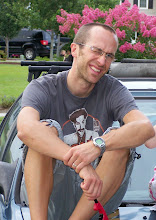
For the first time in three years, I decided to forgo the Lowcountry Race Weekend in favor of some off road racing at Harbison State Park. The Maxxis Race to the River was just the excuse that I needed to sever ties with my old team and start anew. This year, and hopefully for many to come, I will be racing with the Trek Bikes of Mt. Pleasant--Subaru of Charleston Race Team (more about the team later, just know that we have fun). New team, new bike, new discipline.
Drove up early Sunday with a couple of friends (Taylor and Ken--also on the team) for the race at 10:00. It helps going into a race with people you like to ride with; eases the nerves and provides a little motivation. It was a chilly morning in Columbia and having arrived a few hours early we decided to check out the trail for warm-up and reconnaissance. Truth be told, I was feeling really pumped. Maybe it was the new team, new bike, new discipline going through my head, or maybe I was getting a bit cocky from honing my skills on the local trail. Whatever it was disappeared as soon as I went bombing into a turn and then into a tree. Not two minutes in to our leisurely warm-up and I'm in the dirt with Ken and his 29er piled on top of me (all of us laughing hysterically). Ken said he "thought my throttle was stuck." I thought I had better take it easy and just follow. This was mistake number two.
Trying to follow wheels of those way more skilled than you just doesn't work. What works for them, may not work for you. I would hit the deck again before our warm-up was over, this time much harder. (not to be outdone, Taylor did a nice wheelie straight onto his back). I hit a patch of pine-straw, landed hard on my shoulder, and somehow my leg got stuck in my frame. Ken was quick to lend a helping hand and some encouragement. "Let some air out of your tires," he said as he proceeded to do so. "Just ride your own race. Ride your bike." By this time air had left my tires and my sails. I limply rode back to the car where all illusions of victory escaped me. While I sulked and waited in earnest for my race to get underway, Ken was busy texting our (my) adventures. "Hey Geoff," Ken blurted, "Mike says 'Shut up and pedal'." If that's how it's going to be...
The race started with a lot of doubt and not much fanfare. The key to this race (I was told) is to be the first onto the singletrack (which apparently means "trail in the woods"). Knowing this, I half expected there to be an all-out crazed dash from the road to get there. Not so. I think three-quarters of the field was content with just surviving. "Well if you guys don't want those places, I'll be more than happy to take them," I thought. So I did. I charged into the woods in fifth place and quickly overtook fourth. Third place was just ahead of me on the trail, but he was much better than me on technical sections and would slip away. No matter, I had two chasers to worry about. They would yo-yo behind me for another mile and a half, until suddenly, they were gone. Having shed my two pursuers, I could finally focus on riding my own race.
I felt good. I could see third place in the distance and, although unknown to me, the technical sections were gone. As I slowly gained on him, I kept checking for chasers and reciting friends' words of encouragement in my head; "Shut up and pedal." "Just ride your bike." Soon I was on him. I soft-pedaled behind him up a climb and thought, "I could just ride this guy to the finish and smoke him in the sprint." No, this is a race. Someone might catch me. I need to ride my own race.
I waited for us to crest the climb. The whole time this guy had been using a huge gear and now that we were in a flat clearing, he was spinning like mad (that's the thing I noticed about some MTBers, they use really high cadences even when not necessary). I shifted into a bigger gear and laid it down. As a road cyclist, this was my terrain and I was quickly out of sight. Now I was the hunted and my chaser would catch me on the trail on several occasions (he was much better technically than me). I knew as long as I stayed upright that I could distance myself from him in a clearing or in the finish; and outside of a few dicey moments, that is largely what happened. First out of the woods, I sprinted for the finish; I had worked too hard to lose my place now. The result: third place by one second--much to the chagrin of Taylor (second in his race) and Ken (who finished eighth) who were cheering me to the line. I think I could get used to this kind of fun.
Sunday, April 25, 2010

Wednesday, April 14, 2010
There will be Mud
Like King Arthur pulling his sword from the stone, I too have pulled this from my local bike shop; This is X-caliber (Jealous?--You should be. Don't hate it because it's beautiful). Due to my obsession with all things self-propelled and two-wheeled (except recumbents) and wanting to try something new, I decided to finally pull the trigger. Nothing could be more foreign.
 Aptly dubbed a 29er, this thing has massive twenty-nine inch wheels (the standard bike is a twenty-sixer), freakish hydraulic breaks, and feels and sounds like a tank. It is everything a road bike isn't: huge, heavy, and dirty. What a road bike packs in simple elegance, the Gary Fisher X-Cal makes up for as a monstrosity. Rolling over and crushing everything in its path, 29ers leave everything in their wake--like standard MTBs (mountain bikes for short), me (X-cal proved a bit too much to handle and dumped me on several occasions during our first outing), and hopefully the competition (we shall see next week).
What else? This bike allows me to feel free in ways a road bike cannot. I actually feel limited when I'm on the road with it, but not off of it. With it, I can go almost anywhere yet despite this, and despite the lack of cars to contend with, it has its cruelties. Being so close to nature, you would think that you would have time to enjoy it. Not so. The trail requires almost constant attention and delivers almost constant battering. Where road cycling offers much time for introspection, mountain biking requires quick reaction times to avoid trees, holes, roots, and gnarly snakes. Differences aside, they are both fun. I think I could get used to this.
Aptly dubbed a 29er, this thing has massive twenty-nine inch wheels (the standard bike is a twenty-sixer), freakish hydraulic breaks, and feels and sounds like a tank. It is everything a road bike isn't: huge, heavy, and dirty. What a road bike packs in simple elegance, the Gary Fisher X-Cal makes up for as a monstrosity. Rolling over and crushing everything in its path, 29ers leave everything in their wake--like standard MTBs (mountain bikes for short), me (X-cal proved a bit too much to handle and dumped me on several occasions during our first outing), and hopefully the competition (we shall see next week).What else? This bike allows me to feel free in ways a road bike cannot. I actually feel limited when I'm on the road with it, but not off of it. With it, I can go almost anywhere yet despite this, and despite the lack of cars to contend with, it has its cruelties. Being so close to nature, you would think that you would have time to enjoy it. Not so. The trail requires almost constant attention and delivers almost constant battering. Where road cycling offers much time for introspection, mountain biking requires quick reaction times to avoid trees, holes, roots, and gnarly snakes. Differences aside, they are both fun. I think I could get used to this.
Wednesday, March 31, 2010
Relativity
Around 1905, Albert Einstein was busy laying the groundwork on a theory that would change physics forever. A theory that changed humanity forever. Through the development of his theory of Special Relativity (and later, General Relativity), Einstein was able to explain some of the mysteries of our universe and has since been proven correct. To put briefly, his revolutionary theory changed the way people (physicists) thought about space and time (and many other things for that matter).
I make the distinction for physicists for a reason; relativity is a difficult concept for most people to grasp because it is not concrete, intuitive, or conceivable. Relativity's effects are more confined to the realm of nearly massless particles moving near the speed of light whereas Classical (or Newtonian) physics deal with objects of any appreciable mass (a moving human being falls into the latter category). It impacts our lives by dictating the laws of the universe and the vast majority of us, 99.99% of us, will never directly observe it. However, an interesting consequence of relativity is time dilation. Basically stated, time dilation requires that as speed is increased, time slows down relative to a stationary observer (that is, the slowing down if time is not evident to the traveler).
To be sure, Einstein's equations still hold true and reduce to classical equations when applied to humanly achievable speeds. So, if relativity is more applicable to the macro scale of the Universe or on the subatomic quantum scale, why am I spending so much time thinking about it? Because I've been riding my bike; that's why.
Riding my bike provides me with a mental and physical outlet; cycling has allowed me to draw parallels and antitheses to relativity. Recall that a moving object's length and time both contract with respect to a stationary observer. Here's the parallel: to a cyclist pulling at the front of a paceline (or at least for me) these relativistic ideas cross my mind: "If I go a little bit faster, I can make it from here to there sooner...spend less time at the front...end this misery now..." It is as if time and distance are being shortened. Though these thoughts are easily proven by classical physics (as speed equals distance per time), in my mind they are relativistic in nature. Therein lies the undoing of my cycling induced physics lesson; time dilation and length contraction are not apparent to the object in motion.
These perceptions are only in my mind because I have put them there and not because they are actually occurring or are even measurable at such terrestrial speeds. Obviously that won't stop me from thinking about it. Sometimes the mind's perceptions become reality.
Thursday, March 25, 2010
Blythewood sans Roubaix
Sans me too. Anymore the latest craze in bike racing promotions is to add a dirt section to your race and slap the word Roubaix (pronounced roo-bay) at the end of the name. Named after perhaps the most prestigious one day classic, Paris-Roubaix, it implies a race of shear agony and suffering; the result of a few hundred kilometers of racing over multiple cobbled sections. For Blythewood-Roubaix it implied the twist of a few dirt sections around a seven mile loop.
Implied is the operative word. It seems that the Blythewood city engineers forgot to tell the race organizers that they'd be paving over their dirt section; and it seemed that no one told me that racing, despite not riding for nearly two months, wasn't the brightest idea. Oh well, I was going; you've got to cut your teeth sometime and there's no better way to gauge your fitness than racing. Two hours, some wrong directions, and four bottles of urine later, I was ready to race.
The hours leading up to a race are tenuous--sometimes antsy. You want to make sure you stay well hydrated, but get it all out pre-race. You become very adept at pissing in bottles. Nerves also play a role, but strangely as I was warming up, I didn't feel that nervous. Perhaps I was too busy feeling the gusting wind in my face or the nagging pain in my knee. Whatever the case, the race was about to unceremoniously begin.
Without much trouble the pack reached 36 mph on the first lap. The course was surprisingly non-technical (which was a good thing considering the forty-man field), but did include some nasty little climbs. Staying near the front is always key, but never more so than at the base of these climbs. You could easily find yourself in oxygen debt, legs seizing, and off the back in no time at all. This was the first of s aeries of things to cross my mind. The others being: "Wow, my knee doesn't hurt so bad anymore," and "I guess not riding for those three months really wasn't too bad after all," to "I'm losing places like a rock."
In retrospect, it had happened so quickly. I lost place after place until finally I found myself trying to grasp the last wheel of the field. The Phil Liggett play-by-play would have sounded like "he's blown his engine" or "the field has had one look at him and said 'well are you coming or not' and the answer--not". I had blown up spectacularly. I rode another lap and a half alone until getting lapped by the CAT 1s and called it quits. Normally I would have stubbornly rode the extra miles under the guise of the "at least I didn't quit" mantra, but not today and I didn't even feel bad about it. Instead I left with a few takeaways; until I imploded, I had felt pretty good, my knee had stopped hurting, and I could still make it home in time for dinner with the family. These are the important things.
Wednesday, March 17, 2010
Spring Classics
Finally the spring thaw is here. Longer days, less clothes, and the Spring Classics. When most non-crazed cyclists think of the sport, they usually associate it with the Tour de France. While the Tour is the sport's most recognizable spectacle, the spring classics are where the hard men of the sport come to play.
These are beasts of men like Tom Boonen, Fabian Cancellara, and Sitjn Devolder. A few years ago, Devolder, a man whose name rings of how tough he actually is, rode away from his team leader (Boonen) and the entire field at the Ronde van Vlannderen (Tour of Flanders). Climbing the slippery and grimy cobbles of the Koppenburg while wearing the Belgian national champion jersey, Stijn put down the hammer and left the rest of the peloton in his wake; it was all they could do to dismount their bicycles and walk (no joke)! I had never seen anything like it before, but a year later, I would see it again. Soloing across a gap, the Belgian bridged to his attackers and promptly countered, leaving them to watch him and his massive quads and chiseled calves ride away in the distance. I was instantly hooked on the classics and an instant fan of Devolder.
Not to be outdone by a teammate, Tornado Tom, affectionately known as Tomekke by the Belgian masses, has mustered no less than three wins in the Queen of the Classics Paris-Roubaix. One of the oldest races, Paris-Roubaix treats riders and fans to multiple cobbled sections and concludes in a velodrome. If that doesn't sound contradictory? Last year, perhaps fueled by cocaine (Tom is a pretty big partier), Boonen surged and left the field in a fifteen-kilometer cloud of dust. On another occasion, Boonen and two other escapees had such a lead that not even waiting for a passing train allowed their chasers to catch them. The train passed and then Tom summarily dropped his companions. Of course Tom's other win came at the expense of George Hincapie, one of my other favorite riders.
And finally there's Cancellara. Though known more as a time-trialist than as a classics specialist, this Swiss rider ascended from anonymity when he upset some guy named Lance to win the opening prologue of le Tour. Since then he's won two Tours of Switzerland, two World Time Trial Championships (he would have won three, but opted instead to win gold in the 2008 Olympics), countless other races, and Paris-Roubaix. Earning the nickname Spartacus, he is indeed a colossus of roads and one tough dude.
This year be sure to look for these guys in the Ronde along with Paris-Roubaix, and Milan-San Remo, a nearly 300 kilometer march of futility to the Italian coast. They are sure to all be classics.
Sunday, March 14, 2010
The would be McCaves
"...And often she wishes that, when they were born,
She had named one of them Bodkin Van Horn.
And one of them Hoos-Foos. And one of them Snimm.
And one of them Hot-Shot. And one Sunny Jim.
And one of them Shadrack. And one of them Blinkey.
And one of them Stuffy. And one of them Stinkey.
Another one Putt-Putt. Another one Moon Face.
Another one Marvin O'Gravel Balloon Face.
And one of them Ziggy. And one Soggy Muff.
One Buffalo Bill. And one Biffalo Buff.
And one of them Sneepy. And one Weepy Weed.
And one Paris Garters. And one Harris Tweed.
And one of them Sir Michael Carmichael Zutt.
And one of them Oliver Boliver Butt.
And one of them Zanzibar Buck-Buck McFate...
But she didn't do it. And now it's too late."
--Theodor Geisel aka Dr. Seuss
from Too Many Daves
which would be McCave is your favorite?
Monday, March 8, 2010
Fruit Suit Armor
Something occurred to me as I peeled my morning grapefruit. Grapefruit and some varieties of oranges have a thick hides. Clearly nature had given these fruits adequate protection, but has man ever taken advantage of this? I bet not.
It's too bad really, as I bet grapefruit rinds would make good Fruit Suit Armor. What am I talking about? As paleolithic man was busy hunting and gathering, always worrying about threats from animals or other nomads, he was also squandering great opportunities to protect himself. All those fruit rinds he cast aside as waste could've been put to some good use.
No one was out smelting new metals. This was before the iron age or the bronze age, and while animal skins did offer early man some form of protection, there was risk. They had to hunt and kill the animal to get it's skins. Not fruit. Just pluck some from the tree, eat the insides, stitch 'em together with some fish-bone needles and vines and viola, you've got a protective suit made from fruit!
Worn like kneepads, grapefruit rinds could easily prevent skinned knees. Plus, when some prehistoric Pterodactyl tried to eat him, Paleolithic man would taste all funny and bitter. Monarch butterflies employ this same strategy (not the fruit, but the funny taste). Oh what the mind is capable of when allowed to wander.
Subscribe to:
Posts (Atom)